

The landscape of rental housing in India is rapidly evolving. As young working professionals and students move to major cities like Gurgaon, Bangalore, Pune, etc., their expectations of accommodations are changing.
For students and working professionals, traditional rentals with high security deposits are often expensive. PG options can be affordable, but the privacy level, comfort, amenities and services vary considerably between properties.
This is where co-living spaces come in. They usually provide furnished housing as well as a host of other services like security, housekeeping, Internet connectivity, and common spaces for working or leisure. The co-living concept is an option for those who do not wish to go with traditional renting of a house.
This blog will explore the growth of co-living in 2026, the comparison between co-living and rental housing in India, its market trends, and the limitations people should consider before choosing it.
The Co-living Trends in India
The organised co-living sector of India remains relatively small as compared to the potential demand. Urbanisation and migration, especially that of students and professionals, are the key drivers of demand.
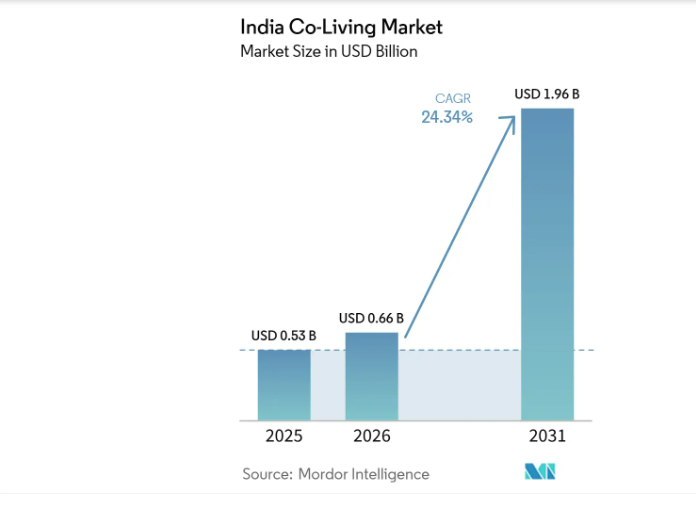
The size of the co-living market in India is expected to increase from $0.53 billion in 2025 to $0.66 billion in 2026 and reach $1.96 billion by 2031, rising at a CAGR of 24.34% over 2026-2031.
Traditional Rental Flats Vs Co-living Space
Not all co-living spaces are superior or more affordable compared to other regular rental apartments. It all depends on the particular place of residence, its operator, services offered, among others.
| Feature | Traditional Rental Flats | Co-living |
| Furnishing | Can range from only a fan and wardrobe to fully furnished. | usually furnished |
| Deposit | Varies by owner and city. | Often minimum or structured differently |
| Community | Independent flats may have limited community. | Shared community spaces and common events |
| Utilities | May be separate | Often included, depending on operators |
| Security | Depends on property | Managed security features of 24/7 CCTV surveillance; app-based access may be available |
| Lease Type | Mostly long-term | Often designed for higher flexibility |
| Amenities | Depends on property | Often include shared amenities |
| Management | Generally landlord-led | Managed by an operator |
The main difference is the ‘service model’. In rental apartments, the dwelling unit is provided, but tenants will have to manage other services. In co-living spaces, the accommodation comes with varying degrees of management and other facilities.
Factors Driving India’s Co-living Market in 2026
There are several factors that are pushing the growth.
- Mobility and Urbanisation
Education and job migration continue to drive demand for housing in large urban areas. Urbanisation and migration of people into the major cities are one of the major factors behind the increased demand for co-living accommodation in India.
For someone moving to a new city, a furnished room with basic services can remove the need to purchase furniture and arrange multiple household services immediately after arrival.
- Increasing Rental Costs and Upfront Expenses
The cost of housing varies greatly among cities and neighbourhoods. Tenants in high-cost rental markets may consider options where the up-front cost is minimised, and the monthly cost is simplified.
The co-living arrangement could enable tenants to save on housing costs by integrating housing services like Wi-Fi, cleaning services and common facilities into their housing fees. Nevertheless, the total cost depends on the city, location, room, service providers and other incorporated services.
Unlike traditional rental PGs or flats with higher security deposits and variable costs, co-living offers affordability through shared infrastructure and predictable costs.
- Flexible Work Culture and Employment Mobility
As professionals travel from city to city due to work and education reasons, there is an increasing need for rental models which do not force occupants to start a permanent household straight away.
Co-living might be considered a solution by providing furnished houses and flexible tenancy options. Nevertheless, different providers have varying lease periods, so the notice period, lock-in period, and terms of exiting the agreement need to be checked before signing one.
- Managed Housing Options
Professional management of rental accommodation is another significant trend. The management can coordinate maintenance, housekeeping, communication with tenants and common facilities through one platform.
This change will help create a systematised rental accommodation industry, but the quality of services will depend on the management and the property itself.
How Co-living Spaces Are Transforming India’s Rental Housing Market
Changing preferences among people are influencing the demand for flexible, furnished and professionally managed accommodation.
- Higher Demand for Convenience
The basic arrangement of a rental that is unfurnished or partially furnished may necessitate that tenants source their own furnishings, connectivity, household utilities, and even services.
In co-living spaces, one can expect a fully furnished environment. Some of the service packages provided include things like Wi-Fi, cleaning, repairs, and other utilities.
This may be significant when moving for work or academic reasons.
- Tech-Friendly Living
Technology is becoming increasingly common within professionally run accommodation. Depending on the type of operator, co-living apartments can provide fast internet connections, electronic rent payments, maintenance request applications, biometric access, and other technology-assisted services.
This can provide residents with greater convenience in terms of renting, especially for those who conduct their business or study from home. Still, the services offered by different co-living properties can differ and therefore cannot be considered universal within the sector.
- Safety and Managed Access
Security is one of the factors that have to be considered when relocating to new cities. Professionally operated co-living spaces can offer amenities like CCTV surveillance, gated entry, security guards, and even digital access control systems.
The problem is that there is no standardised level of security in co-living spaces. It is recommended to conduct an inspection of the property beforehand.
For example, co-living spaces in Gurgaon may offer different facilities and security arrangements depending on the property.
- Community
Some of the most obvious distinctions between co-living and traditional rental are the existence of communal spaces.
People may be provided with communal lounges, kitchen spaces, leisure spots, or places for studying/working. Such spaces can help recent immigrants in cities to get acquainted with other people.
Nevertheless, community living is not for everyone. Those people who require total privacy may opt for separate studio apartments.
- Flexible Option for Mobile Residents
The organised co-living sector is specifically relevant to people who do not want to set up a permanent household immediately.
According to Mordor Intelligence’s estimates, working professionals made up 65.7% of co-living demand in 2025, meaning that the industry caters to a significant number of professionals besides students.
This shows that co-living is not limited to students, but working professionals form an important part of the recent tenant base.
Future of Co-living in India
Prospects for co-living in India continue to look good as rentals are continuously developing into more professional and organised operations. Rising demand for furnished homes, flexible rentals, amenities and tech-driven facilities may help to propel this industry.
Technology will continue to play a crucial role in these developments, especially in matters concerning payments, communications, property management and access controls. With professionally managed property, rental services may benefit from these technologies to become more efficient.
Consistency of services provided, clear price structures, security, safety and customer satisfaction will be some of the concerns that will require close attention as the co-living industry expands. Growth in co-living spaces will thus be dependent not just on increasing numbers of available properties but also on the quality of their offerings.
Conclusion
Co-living has emerged as an increasingly pertinent concept in India’s rental housing market in 2026. The phenomenon of co-living is the result of migration trends in Indian cities, higher demand among students and working professionals, and the preference for ready-to-live premises. This is a new trend of thinking on the part of renters regarding conveniences, service provision and community.
From the perspective of many renters, co-living can be viewed as a convenient replacement for standard renting where the renter does not need to purchase furniture and arrange utilities and other necessary household facilities. However, co-living is not necessarily the cheaper or better solution. It really depends on the particular needs of the renter concerning budget, privacy, location, lease terms and other specifics of the rented premises.
In view of the development of the rental housing market in India, co-living may continue to play a crucial role in the development of more organised, service-based renting practices. In order for co-living to be successful in the long run, the operators of the segment should ensure constant high-quality service provision, clear pricing and high standards of security.
Frequently Asked Questions:
1. What is co-living in India?
Co-living is a professionally managed rental system where individuals usually get either private or shared rooms along with common area usage rights. Depending upon the individual property, rent might include certain services like Wi-Fi, cleaning and maintenance charges and utility services.
2. Who typically prefers co-living?
Working professionals and students are key consumers of such services. Mordor Intelligence says that working professionals made up 65.7% of the demand for such services in 2025.
3. Can co-living be considered an economical option as compared to renting a flat?
Co-living can be cost-effective in certain cities since there are numerous amenities which can be covered in one payment. However, the cost will differ from one city to another depending on the property, services, and type of room.
4. What amenities do co-living spaces have?
Services vary with the operators, but some typical amenities can include furnished rooms, Wi-Fi, cleaning and maintenance, kitchen facilities, lounges, workspaces, security features and recreational features, among others.